
What Allows a Country Garden Belong to Its Landscape?
All design is of its time.
Culture, society and economics provide the reference points from which design emerges. Gardens are no different. Landscapes are cultural expressions: sometimes made in harmony with the natural world, sometimes in rather violent oppression of it, and more often somewhere complicated in between.
But every country garden also has its own particular context. A house, a piece of land, a particular topography, a history, geology, trees, vistas, agricultural patterns, previous owners and the accumulated decisions of generations. Together, these create a set range of possibilities — some natural, some improbable, some that should probably be left alone.
The question is what makes one response feel as though it belongs.
At the very greatest country estates the distinction between garden and landscape can almost disappear. Stowe, Rousham and Stourhead do not simply occupy their landscapes. To a large extent, they become them.
Their scale is exceptional, of course, and so were the circumstances that produced them. But the interesting question is not whether we should attempt to recreate the eighteenth-century English landscape garden. We shouldn't — at least, we should not feel we have to. It is what these places can teach contemporary stewards and designers about creating a country garden that feels specific, coherent and inseparable from the wider landscape in which it sits.
Three things interest me particularly: story, aesthetic discipline and personality.
Stowe: landscape as story
Stowe is an extraordinary example of a landscape being asked to carry a narrative.
Its temples, monuments, statues and carefully orchestrated views were not scattered ornament. Together they created a world of associations — antiquity, politics, virtue, power, memory — embedded within the experience of moving through the landscape.
You do not simply look at Stowe. You progress through it.
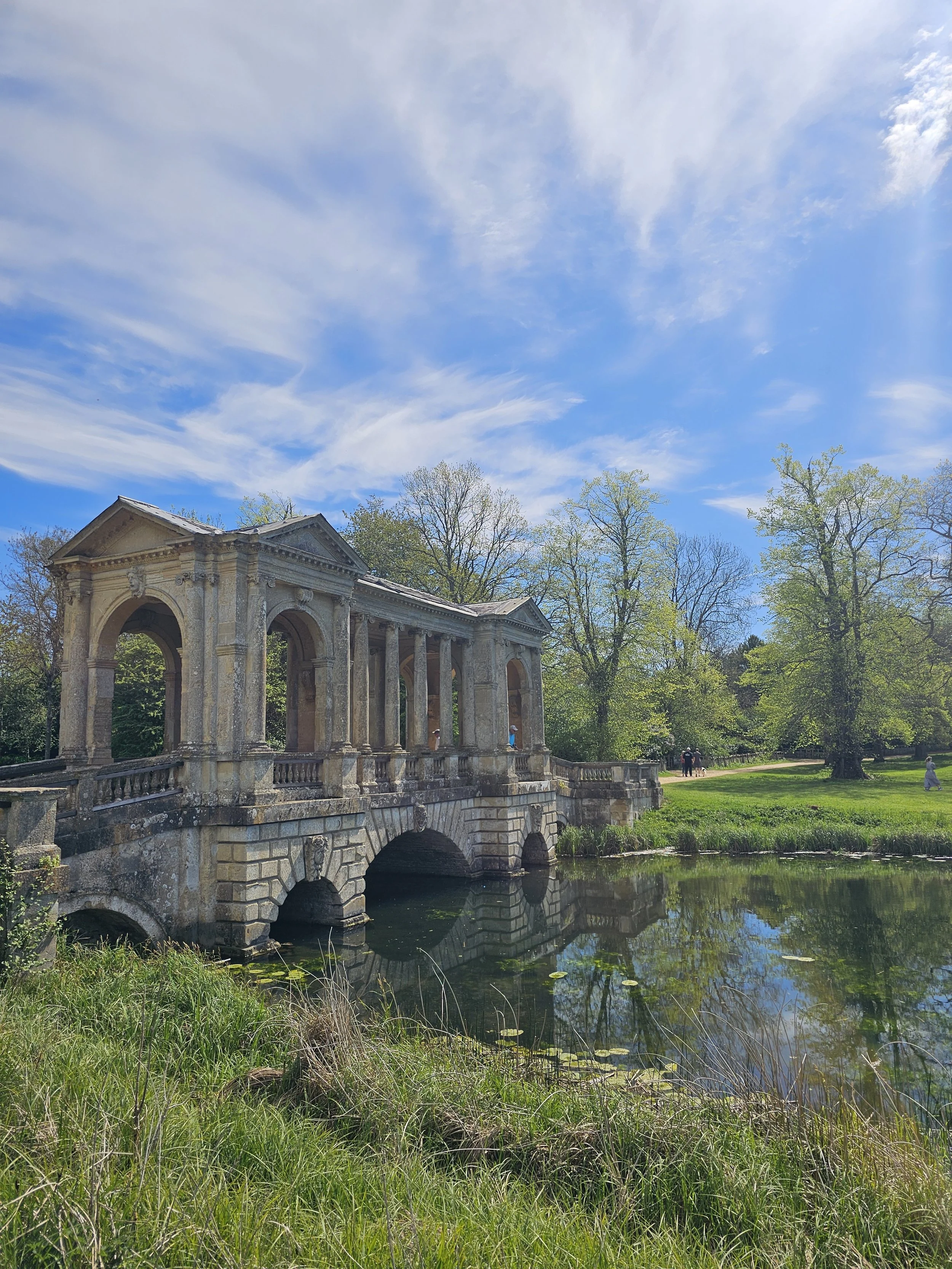
The glorious Palladian Bridge of Stowe continues the narrative of place - antiquity, grandeur and drama.
One building appears across water. Another waits at the end of an axis. A monument gains meaning because of what came before it and what can be seen beyond. The landscape becomes sequential, almost theatrical, and the act of walking through it becomes part of the story.
The theatrical connection is not merely a metaphor. Landscape historian John Dixon Hunt has written extensively about the relationship between gardens and theatre, particularly the way earlier European gardens developed as sequences of scenes, associations and staged encounters between art and nature. In Garden and Grove, he traces that theatrical inheritance into the English imagination. Stowe belongs to that tradition: landscape experienced not as a single composition, but through movement and revelation.
What interests me is that this narrative was inseparable from the lives and interests of the people who made it. Classical antiquity provided the language, but the landscape was not an archaeological reconstruction. It was being used creatively, to express something about its owners and the world in which they lived.
That distinction still matters.
A contemporary garden does not require temples to have a story — though I am partial to a post-modern folly. In fact, most would be much better without them. But a landscape becomes richer when its decisions are connected by an idea, particularly when that idea comes from something genuine about the place or the people who will live there. Story can give apparently separate spaces a reason to belong to one another.
Rousham: aesthetic discipline
Rousham does something different.
What always strikes me there is its discipline. The palette is remarkably restrained. Materials repeat. Plants are deployed with confidence and, often, at considerable scale. Rather than introducing a new idea every few metres, the same language is allowed to gather force through repetition.
That restraint gives the landscape clarity.
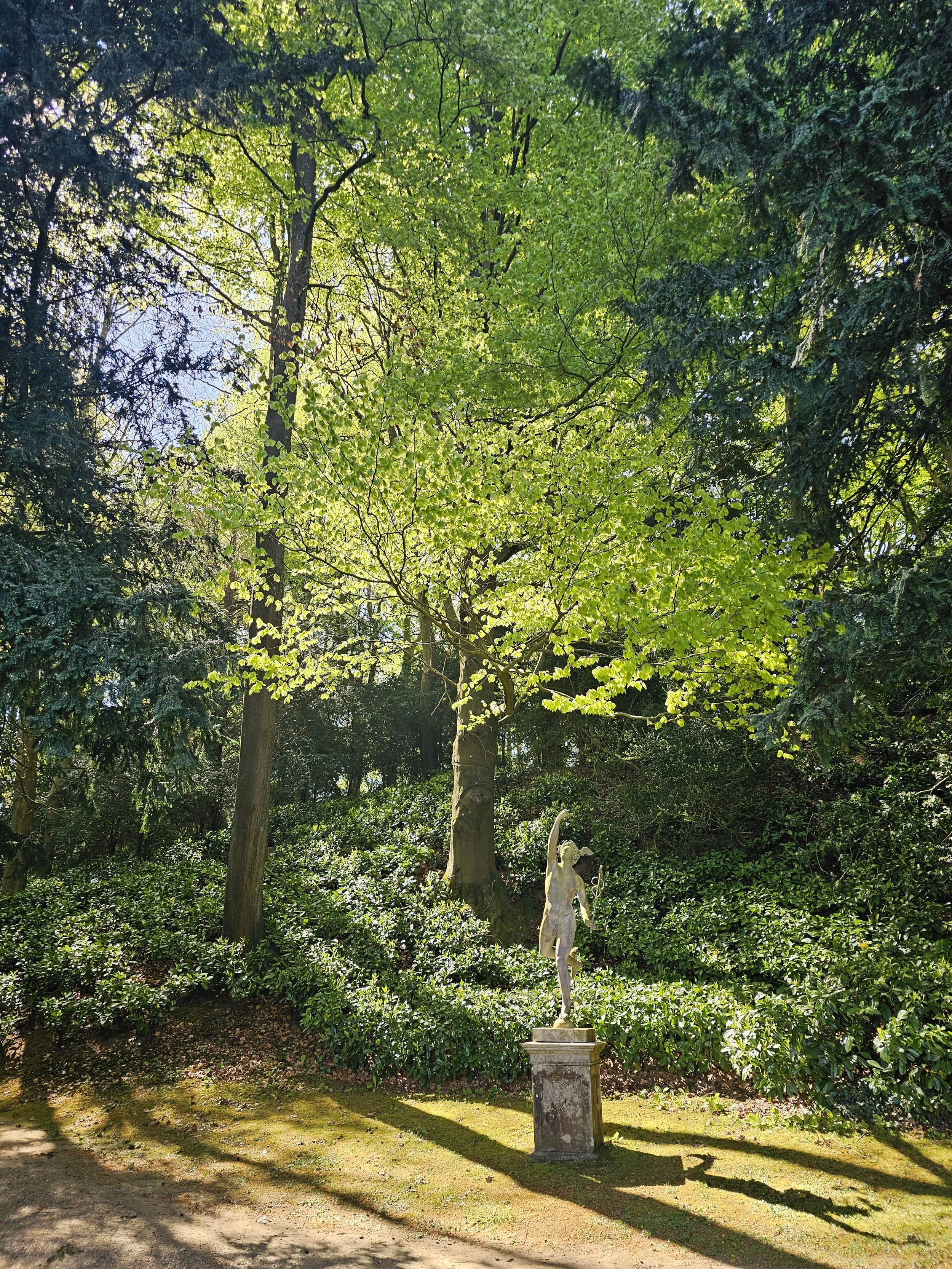
A restrained planting mixture of meadow, laurel, beech and yew gives coherence and atmosphere to large areas of the estate.
There are also extraordinarily strong lines of connection through the garden and into the country beyond it. Avenues of lime trees pull the eye outwards. Follies occupy distant points. Ha-has allow parkland to approach without the interruption of a visible boundary. The garden is defined, but never feels sealed off. This is one of the great lessons of country garden design. A boundary on a plan need not become a boundary in the imagination.
The wider landscape can be borrowed, framed, hidden and revealed. Trees beyond the property may be visually more important than plants within it. A distant field, church tower, hill or piece of woodland can become part of the composition without belonging to the owner at all.
And discipline matters because connection is easily lost through excess. Too many materials, too many plant communities, too many competing gestures and the landscape begins to fracture.
Rousham knows what language it is speaking. Then it speaks it beautifully.
Great Dixter: personality
Great Dixter is different again.
It is probably my favourite garden. Not because it is the most immaculate, or the grandest, or because every part resolves neatly into a single idea. Quite the opposite. What I love is that you can feel the personality of the people who have shaped it.
The garden has changed through successive hands, but those layers do not cancel one another out. They accumulate.
It is unmistakably rooted in the Arts and Crafts tradition, yet it never feels like a museum of Arts and Crafts gardening. Nor does it detach itself from the agricultural vernacular around it. House, barns, hedges, meadow, orchard, topiary and exuberant planting somehow inhabit the same world. There is scholarship there, certainly, and enormous horticultural skill. But there is also nerve.
Plants collide. Scale changes unexpectedly. Some moments are restrained and others almost riotous. You are constantly aware that somebody has made a choice.
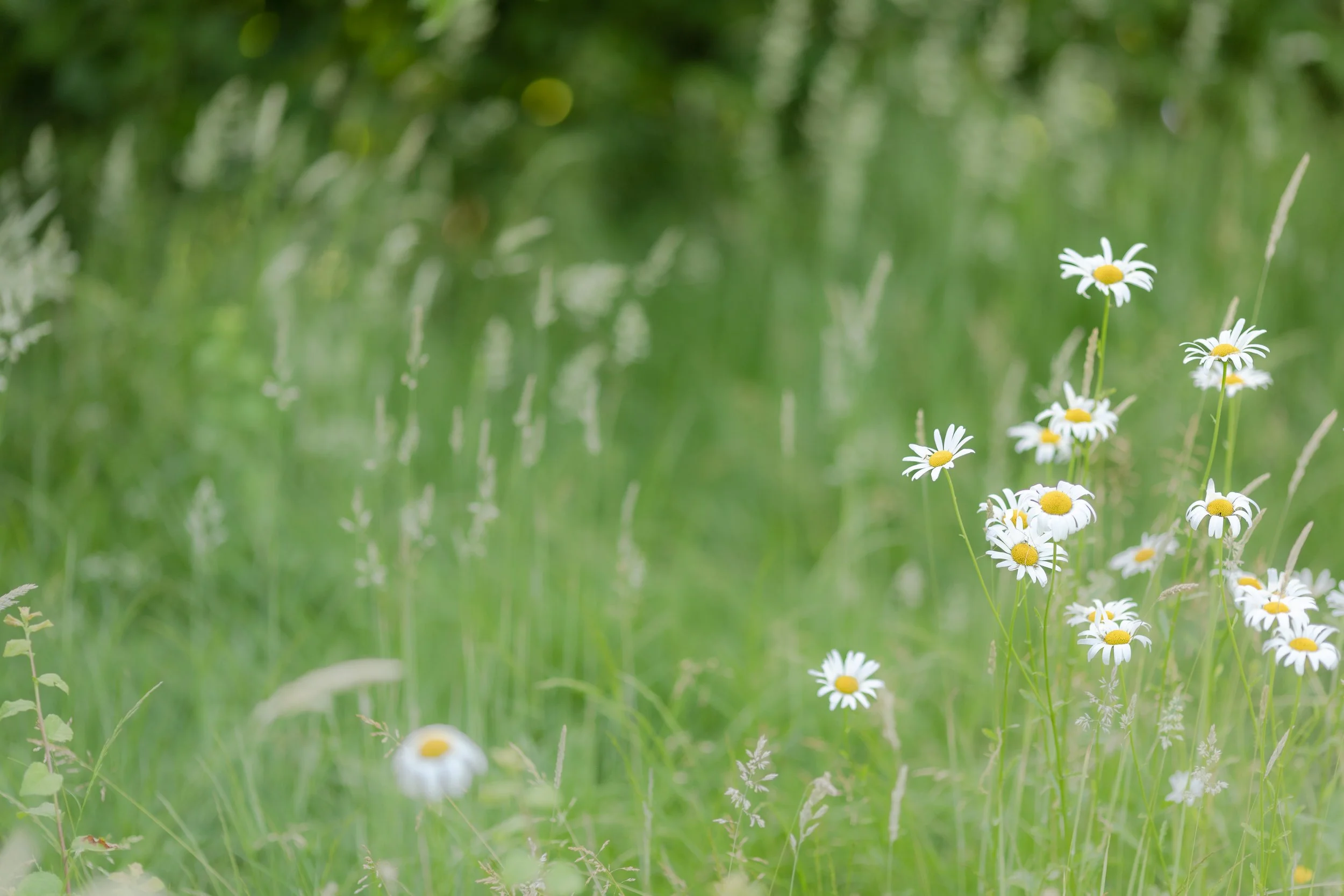
The gentle meadows of Great Dixter surround and bind the more formal spaces near the house.
For me, that is what gives the garden soul.
Personality in a landscape is not the same as eccentricity for its own sake. Nor is it imposing a designer's signature regardless of place. It comes when somebody looks hard at what is there, forms a judgement, and then has sufficient confidence to add something of themselves.
Great Dixter belongs to its landscape because it is deeply rooted in that landscape — but it also belongs unmistakably to the people who have made it.
That tension matters.
Stonehurst: putting the principles to work
I have been exploring these same questions at Stonehurst, a twenty-acre garden in East Sussex. The starting point was already formidable.
The house sits high on a steep slope above the Sussex Weald, with strong remnants of an earlier Thomas Mawson landscape providing a robust architectural inheritance. The temptation with a place like this is either to become deferential to the point of paralysis, or to behave as though history can simply be cleared away to make room for something new. Capability Brown certainly suffered from the occasional bout of god-syndrome.
Neither interested me.
The first task was aesthetic discipline: understanding the existing landscape well enough to know which rules deserved to survive.
That meant sympathetic materials, attention to mass and proportion, strong framing of views and an acknowledgement of the Arts and Crafts character already present. New interventions needed enough confidence to hold their own, but they also needed to feel as though they understood where they had arrived.
Then came story.
The new owners have a passion for ornithology, and this became a way of giving the masterplan another layer of meaning. A series of interconnected spaces were each associated with a bird of particular interest, the bird acting almost as a totem for the character of that part of the garden. The Bird of Paradise Garden is deliberately exotic: bold colour, richer planting and a sense of display. The Nightingale Orchard is almost the opposite. Quieter. More elusive. Something discovered rather than announced.
The idea gave the spaces individual identities without requiring them to become disconnected episodes. They belong to one landscape, but they are allowed different moods.
And then there is the place itself.
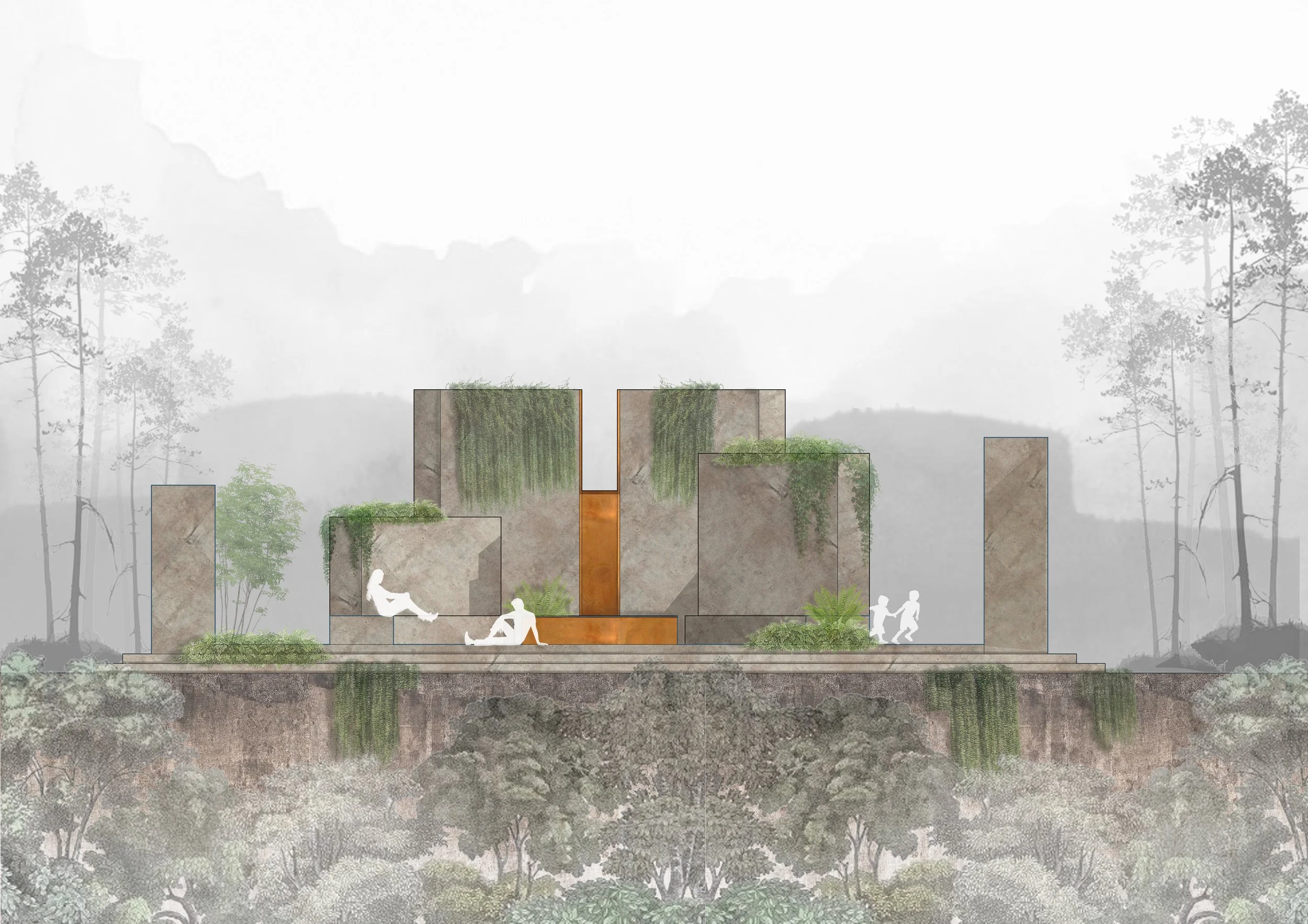
The Ornithomancy - a post modern folly conceived for Stonehurst - drawing inspiration from the ancient belief in divination through the behaviour of birds.
Stonehurst has an extraordinary piece of topography: a steep cliff dropping towards a hidden valley, while elsewhere long views open across the Sussex Weald. Those conditions could never simply be treated as a backdrop to the garden. They had to become part of its structure. Some interventions are therefore about restraint and framing. Others are intentionally more forceful.
Around the house, I introduced large rectilinear hedges in the design to help ground the architecture on its steep slope. Their scale and geometry are deliberately strong — reminiscent, in my mind, of the mass and spatial confidence of Richard Serra's land art. Not an imitation, but a useful way of thinking about weight, enclosure and the relationship between an object and the ground beneath it.
Elsewhere, the landscape is allowed to loosen as it moves away from the house.
That transition is important. A country house landscape should not simply stop at an arbitrary line and allow the landscape beyond to begin. The relationship needs to be negotiated. At Stonehurst, the ambition is for the garden to become increasingly immersed in the wider landscape: sometimes framing it, sometimes borrowing from it, and sometimes disappearing into it altogether.
Belonging
Perhaps that is the common thread.
Stowe belongs through story.
Rousham through aesthetic discipline and its extraordinary command of connection.
Great Dixter through personality.
The strongest country gardens contain all three.
They understand the landscape they have inherited without becoming imprisoned by it. They know when to repeat and when to interrupt. They contain something of their owners, something of the place and something of the designer who has interpreted both. And crucially, they recognise that the landscape does not end at the garden boundary.
For contemporary designers and stewards, this may be the most useful lesson of all. We are not designing isolated objects. We are adding another layer to places that existed before us and, with luck, will continue long afterwards.
A garden belongs when that new layer feels neither anonymous nor imposed. It feels particular. As though, after all the possible gardens that might have been made there, this was the one that could only have happened in this place.
